
 By Maxmulsoft
2026-06-24 08:08:20
Comments
(0)
412
By Maxmulsoft
2026-06-24 08:08:20
Comments
(0)
412
How to Develop a Chatbot: A Complete Guide for Businesses in 2026
In today's digital world, businesses are increasingly adopting AI-powered chatbots to improve customer service, automate processes, and enhance user engagement. Whether you run an eCommerce store, educational institution, healthcare service, or corporate website, a chatbot can significantly improve customer experience while reducing operational costs.
This guide explains how to develop a chatbot from scratch and the essential technologies involved in creating an intelligent conversational assistant.
What is a Chatbot?
A chatbot is a software application designed to simulate human conversation through text or voice interactions. Modern chatbots use Artificial Intelligence (AI), Natural Language Processing (NLP), and Machine Learning (ML) to understand user queries and provide relevant responses.
Chatbots can be integrated into websites, mobile applications, social media platforms, and messaging services such as WhatsApp, Facebook Messenger, and Telegram.
Benefits of Chatbot Development
1. 24/7 Customer Support
Chatbots provide instant responses to customer inquiries at any time of the day, improving customer satisfaction and reducing response times.
2. Cost Reduction
Businesses can automate repetitive customer interactions, reducing the need for large customer support teams.
3. Improved User Engagement
Interactive conversations keep users engaged and help businesses generate more leads and conversions.
4. Faster Response Times
Customers receive immediate answers without waiting for human representatives.
5. Lead Generation and Qualification
Chatbots can collect user information, qualify leads, and direct potential customers to the appropriate sales team.
Types of Chatbots
Rule-Based Chatbots
These chatbots follow predefined rules and decision trees. They are suitable for answering frequently asked questions.
AI-Powered Chatbots
These chatbots use machine learning and NLP to understand context and provide intelligent responses.
Hybrid Chatbots
A combination of rule-based and AI-powered systems that offer enhanced flexibility and accuracy.
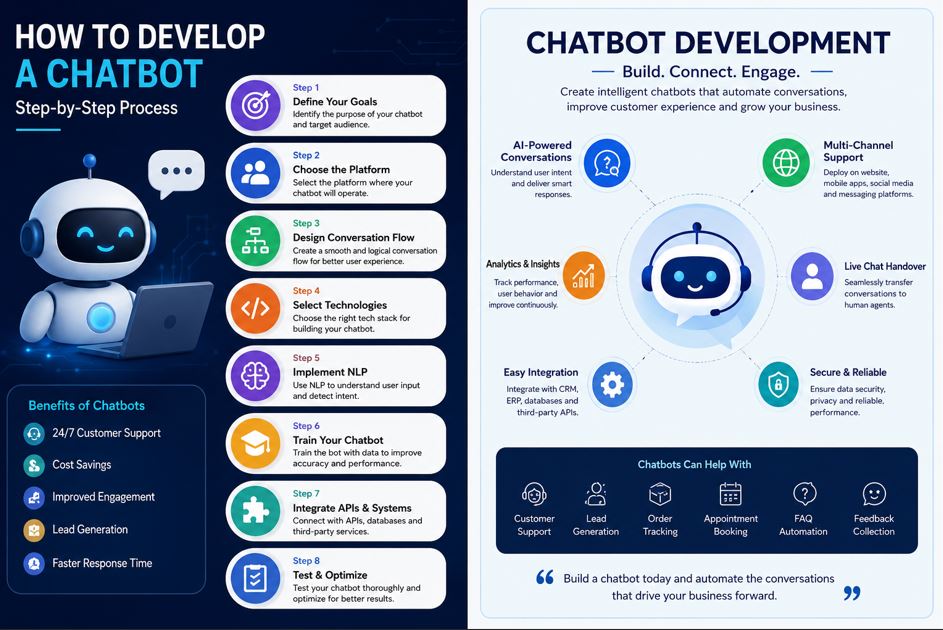
Steps to Develop a Chatbot
Step 1: Define Your Goals
Before development begins, identify the chatbot's purpose:
Customer support
Lead generation
Appointment booking
Product recommendations
Internal employee assistance
Clear objectives help determine the chatbot's functionality and design.
Step 2: Choose the Right Platform
Select where your chatbot will operate:
Business Website
Mobile Application
WhatsApp
Facebook Messenger
Telegram
Instagram
Customer Support Portal
Step 3: Design the Conversation Flow
Create a structured conversation flow that includes:
Welcome messages
User questions
Decision-making paths
Escalation to human agents
Closing interactions
A well-designed flow ensures a smooth user experience.
Step 4: Select Development Technologies
Common technologies used in chatbot development include:
Frontend Technologies
HTML5
CSS3
JavaScript
React.js
Vue.js
Backend Technologies
Node.js
Python
PHP
Java
.NET
Database Solutions
MySQL
PostgreSQL
MongoDB
Firebase
AI and NLP Frameworks
OpenAI GPT Models
Google Dialogflow
Microsoft Bot Framework
Rasa
IBM Watson Assistant
Step 5: Implement Natural Language Processing
NLP allows the chatbot to understand human language and user intent. This includes:
Intent Recognition
Entity Extraction
Context Management
Sentiment Analysis
Advanced NLP significantly improves chatbot accuracy and user satisfaction.
Step 6: Train the Chatbot
Provide training data that includes:
Frequently Asked Questions
Customer Support Queries
Industry-Specific Information
Business Policies
Continuous training improves chatbot performance over time.
Step 7: Integrate APIs and Business Systems
Modern chatbots often connect with:
CRM Software
ERP Systems
Payment Gateways
Booking Platforms
Inventory Management Systems
API integration enables real-time information exchange.
Step 8: Test and Optimize
Perform extensive testing to ensure:
Accurate responses
Smooth conversation flow
Error handling
Mobile compatibility
Fast performance
Regular optimization helps maintain effectiveness.