
 By Maxmulsoft
2026-07-04 10:01:10
Comments
(0)
289
By Maxmulsoft
2026-07-04 10:01:10
Comments
(0)
289
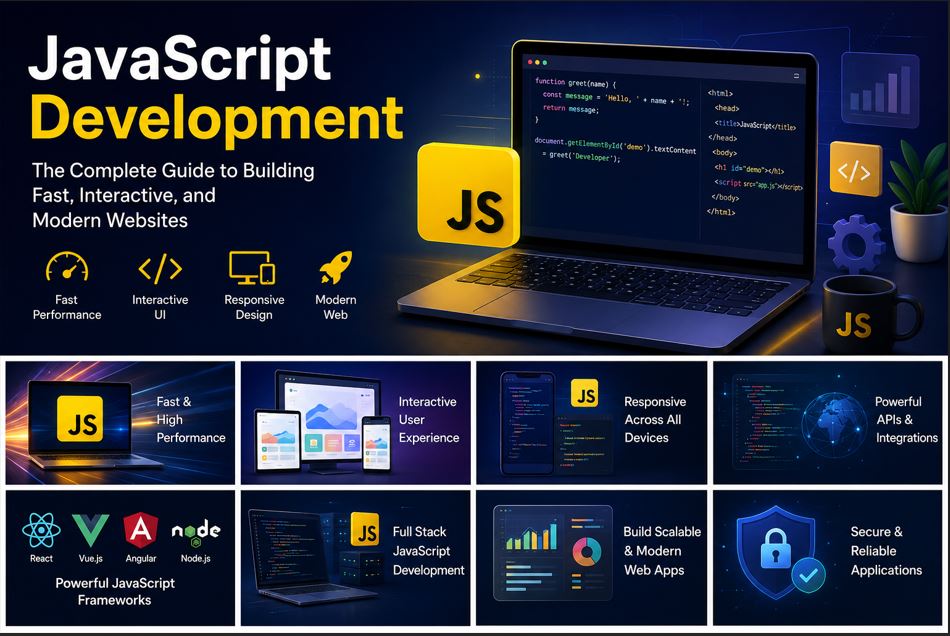
JavaScript Development: The Complete Guide to Building Fast, Interactive, and Modern Websites
Introduction
In today's digital world, users expect websites to be fast, interactive, and responsive. Whether you're shopping online, using a banking portal, attending virtual classes, or managing your business through a dashboard, JavaScript powers many of the features that make these experiences seamless.
JavaScript is one of the world's most widely used programming languages and has become the backbone of modern web development. From simple animations to enterprise-level web applications, JavaScript enables developers to build engaging, scalable, and high-performance digital solutions.
If you're planning to develop a modern website or web application in 2026, JavaScript should be at the centre of your technology stack.
What is JavaScript?
JavaScript is a high-level, lightweight, object-orientated programming language primarily used to create interactive and dynamic websites.
Originally designed to enhance static HTML pages, JavaScript has evolved into a full-stack programming language capable of powering the following:
- Interactive Websites
- Business Applications
- Enterprise Portals
- Progressive Web Apps (PWA)
- Single Page Applications (SPA)
- Real-Time Chat Applications
- Online Learning Platforms
- Social Media Platforms
- E-commerce Websites
- Cloud-Based Applications
Today, JavaScript runs not only inside web browsers but also on servers through Node.js.
Why JavaScript is So Popular
Millions of businesses rely on JavaScript because it offers:
- Fast execution speed
- Cross-platform compatibility
- Rich ecosystem
- Massive developer community
- Thousands of open-source libraries
- Easy integration with APIs
- Excellent performance
- Scalable architecture
- Continuous updates
- Strong industry demand
Key Features of JavaScript
1. Dynamic Content
JavaScript allows web pages to update content instantly without reloading.
Examples include:
- Live notifications
- Auto-refresh data
- Dynamic forms
- Interactive dashboards
2. Event Handling
JavaScript responds instantly to user actions, like:
- Mouse clicks
- Keyboard input
- Touch gestures
- File uploads
- Form submissions
3. Asynchronous Programming
Using Promises and Async/Await, JavaScript loads data in the background without freezing the user interface.
Examples include:
- Loading comments
- Fetching products
- Payment verification
- Live search
4. DOM Manipulation
JavaScript can modify HTML and CSS dynamically.
This allows developers to create:
- Animations
- Interactive buttons
- Image sliders
- Popups
- Accordions
- Tabs
5. API Integration
JavaScript easily connects websites with external services.
Popular integrations include:
- Payment Gateway
- Google Maps
- Weather API
- AI APIs
- WhatsApp API
- Social Login
- Email Services
6. Cross-Browser Support
Modern JavaScript works efficiently across major browsers, including:
- Chrome
- Firefox
- Edge
- Safari
- Opera
Advantages of JavaScript Development
Businesses choose JavaScript because it provides:
- Faster website performance
- Better user experience
- Responsive interfaces
- Reduced server load
- Real-time functionality
- Easy maintenance
- Excellent scalability
- SEO-friendly implementation (with modern frameworks)
- Cost-effective development
Huge talent pool