
 By Maxmulsoft
2026-06-27 12:28:41
Comments
(0)
305
By Maxmulsoft
2026-06-27 12:28:41
Comments
(0)
305
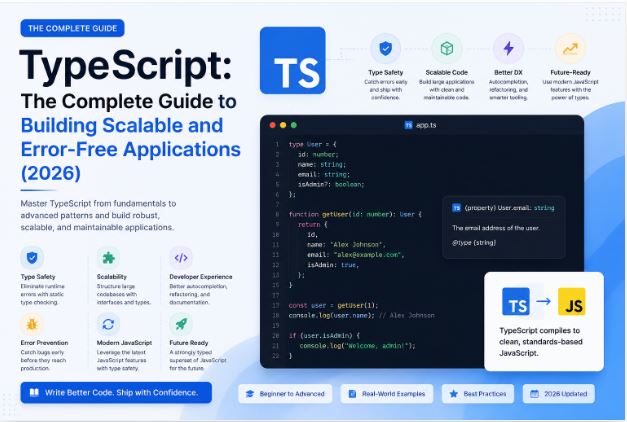
TypeScript: The Complete Guide to Building Scalable and Error-Free Applications (2026)
TypeScript: The Future of JavaScript Development
Modern web applications are becoming increasingly complex, requiring developers to write clean, maintainable, and reliable code. While JavaScript remains one of the most popular programming languages, managing large-scale applications can become difficult without proper type checking and structure.
TypeScript addresses these challenges by adding static typing, improved tooling, and better code organization to JavaScript. Developed by Microsoft, TypeScript has become the preferred language for many development teams building enterprise-grade web applications, APIs, and cloud-based software.
Whether you're creating a startup MVP, an enterprise platform, or a SaaS application, TypeScript helps improve development speed, reduce bugs, and make code easier to maintain.
What is TypeScript?
TypeScript is an open-source programming language that extends JavaScript by adding optional static typing and modern development features.
Because TypeScript is a superset of JavaScript, every valid JavaScript program is also valid TypeScript. Developers can gradually adopt TypeScript without rewriting an existing project from scratch.
TypeScript code is compiled into standard JavaScript, allowing it to run in all modern browsers and JavaScript environments.
Why Developers Prefer TypeScript
TypeScript has become one of the most widely adopted technologies because it improves developer productivity and application reliability.
Its major benefits include:
- Early error detection during development
- Strong type safety
- Better code readability
- Easier debugging
- Excellent IDE support
- Improved auto-completion
- Simplified refactoring
- Better collaboration for large development teams
Key Features of TypeScript
Static Type Checking
TypeScript checks data types before your code runs, helping catch many common mistakes during development rather than after deployment.
Example benefits include:
- Fewer runtime errors
- More predictable code
- Easier maintenance
- Better documentation through types
Object-Oriented Programming Support
TypeScript fully supports modern object-oriented programming concepts such as:
- Classes
- Interfaces
- Inheritance
- Encapsulation
- Access modifiers
- Generics
These features make it easier to build reusable and scalable applications.
Excellent Developer Experience
Modern editors provide powerful TypeScript support, including:
- Intelligent code completion
- Real-time error detection
- Automatic imports
- Code navigation
- Safe refactoring
- Inline documentation
This speeds up development and improves productivity.
Better Code Organization
Large applications become easier to manage because TypeScript encourages:
- Modular architecture
- Reusable components
- Consistent coding standards
- Clear interfaces
- Well-defined data models
Advantages of TypeScript
Using TypeScript offers several business and technical advantages:
- Reduced software bugs
- Faster development cycles
- Easier project maintenance
- Improved team collaboration
- Better scalability
- Safer code refactoring
- Enhanced code quality
- Strong IDE integration
- Improved documentation
- Greater confidence during deployments
Where TypeScript is Used
TypeScript is widely used across different industries and project types, including:
- Enterprise Software
- SaaS Platforms
- E-commerce Websites
- CRM Systems
- ERP Solutions
- Banking Applications
- Healthcare Platforms
- Education Portals
- AI Dashboards
- Cloud Applications
- Mobile Apps
- Real-Time Applications
Popular Frameworks That Support TypeScript
TypeScript integrates seamlessly with many popular technologies:
Frontend
- React
- Next.js
- Angular
- Vue.js
Backend
- Node.js
- Express.js
- NestJS
Mobile
- React Native
- Ionic
Because of its flexibility, TypeScript is suitable for both frontend and backend development.
Best Practices for TypeScript Development
To build reliable and maintainable applications:
- Enable strict type checking.
- Define clear interfaces for data models.
- Avoid using the
anytype unless absolutely necessary. - Use reusable utility types.
- Organize code into modules.
- Write meaningful comments where needed.
- Keep dependencies up to date.
- Follow consistent naming conventions.
- Add automated testing to your development workflow.
Why Businesses Should Choose TypeScript
Businesses benefit from TypeScript because it helps development teams deliver high-quality software faster.
Its advantages include:
- Lower maintenance costs
- Faster onboarding of new developers
- Improved application stability
- Easier long-term scalability
- Better software quality
- Reduced production issues
- Improved customer experience
For organizations investing in digital transformation, TypeScript provides a strong foundation for building secure, scalable, and future-ready applications.
Conclusion
TypeScript has transformed modern JavaScript development by combining flexibility with reliability. Its static typing, excellent tooling, and strong support for scalable architecture make it an ideal choice for projects of all sizes.
Whether you're building a business website, an enterprise platform, a cloud application, or a full-stack SaaS product, TypeScript helps teams write cleaner code, reduce errors, and deliver software with greater confidence.
As the demand for high-performance and maintainable applications continues to grow, TypeScript remains one of the most valuable technologies for developers and businesses in 2026 and beyond.